
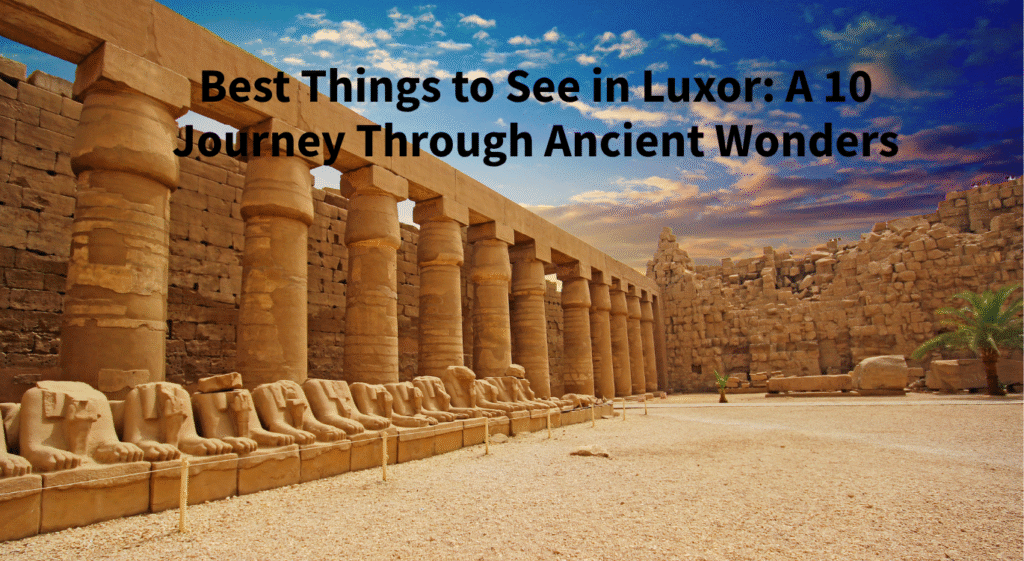
Welcome to Luxor, the world’s greatest open air museum where every sunrise lights up temples older than time, and every sunset paints the Nile in gold. If you’ve ever dreamed of walking through living history, Luxor is your invitation to do just that. In this guide, we’ll uncover the 10 best things to see in Luxor from the majestic Karnak Temple and mysterious Valley of the Kings, to tranquil Nile cruises and vibrant local markets. Each place tells a story, each corner hides a secret, and together they form an experience that defines Egypt’s timeless magic.
Discover the Valley of the Kings
The Valley of the Kings, one of the most iconic things to see in Luxor, houses over 63 royal tombs dating back to Egypt’s New Kingdom 1550–1070 BC. These subterranean chambers reveal exquisite wall paintings preserved with over 80% of their original pigments, a marvel of ancient craftsmanship. The tomb of Tutankhamun alone attracted more than 1.5 million visitors in recent years. Exploring this UNESCO site offers not just history, but a scientific glimpse into ancient burial engineering and color preservation.
Exploring Karnak Temple: Ancient Wonder
Among the grandest things to see in Luxor, Karnak Temple spans over 200 acres and contains 134 colossal columns, each soaring up to 21 meters high. Built across 13 centuries, it reflects unmatched architectural precision aligned with astronomical patterns; the winter solstice still illuminates its central axis. Studies by Egyptologists show its sandstone blocks weigh up to 70 tons, assembled with mathematical symmetry. Visiting Karnak isn’t just sightseeing, it’s witnessing the scientific genius of one of humanity’s earliest civilizations.
Know More About should i travel to egypt right now
The Allure of Luxor Temple
Located in the heart of modern Luxor, the Luxor Temple remains one of the most captivating things to see in Luxor, built around 1400 BC by Pharaohs Amenhotep III and Ramses II. The temple’s alignment with the Nile’s east–west axis symbolizes rebirth, while its colossal statues, some exceeding 15 meters, showcase precision unmatched even by today’s engineering standards. Archaeological data indicate that more than 75% of its reliefs still retain original inscriptions, offering a living timeline of Egypt’s dynastic power and solar worship.
Valley of the Queens: Royal Mystique
Home to over 90 tombs, the Valley of the Queens stands as one of the most elegant things to see in Luxor. Built between 1290 and 1070 BC, it served as the eternal resting place for royal wives and princesses. The tomb of Queen Nefertari, restored by the Getty Conservation Institute, retains more than 80% of its original colors, earning it the title “Egypt’s most beautiful tomb.” Scientific pigment analysis reveals the use of natural minerals like malachite and other proof of ancient Egypt’s mastery of art and chemistry.
The Allure of Luxor Temple
Among the most fascinating things to see in Luxor, the Luxor Temple offers a rare fusion of history and science:
- Constructed circa 1400 BC by Amenhotep III and later expanded by Ramses II.
- Perfectly aligned with the Nile’s solar axis, marking ancient festivals of rebirth.
- Features six colossal statues, each over 15 meters high, carved from single sandstone blocks.
- Archaeologists report significant preservation of original reliefs, revealing dynastic transitions and solar worship rituals.
Know More About What is the best tour company for Egypt
Valley of the Queens: Royal Mystique
For travelers seeking regal beauty, this valley ranks high among the must see things to see in Luxor:
- Contains over 90 tombs, mainly for queens and royal children of the 19th Dynasty.
- The tomb of Queen Nefertari retains around 80% of its vivid pigments, thanks to modern conservation.
- Pigment analyses revealed natural minerals like malachite green and red ochre, proving advanced ancient chemistry.
- Hieroglyphic reliefs illustrate celestial journeys, offering scientific insights into ancient Egyptian cosmology.
The Colossi of Memnon: Guardians of History
Standing at the western entrance of Luxor, the Colossi of Memnon are among the most imposing things to see in Luxor.
- Each statue stands about 18 meters high and weighs nearly 720 tons, carved from single blocks of quartzite sandstone.
- Built around 1350 BC to guard the mortuary temple of Amenhotep III, they once flanked a complex that spanned over 35 hectares.
Hatshepsut Temple: Legacy of a Female Pharaoh
The Temple of Hatshepsut, carved directly into the cliffs of Deir el Bahari, stands as one of the most extraordinary things to see in Luxor.
- Constructed in the 15th century BC, it honors Queen Hatshepsut, Egypt’s first great female ruler.
The temple features three ascending terraces linked by ramps, extending nearly 270 feet in length. - Excavations have revealed evidence of advanced stone cutting techniques and pigment use exceeding 3,400 years in age.
Know More About What is the best tour company for Egypt
Hot Air Balloon Ride at Sunrise
For a truly breathtaking experience, a hot air balloon ride over Luxor is one of the most unforgettable things to see in Luxor.
- Flights typically reach heights of 500 to 1,000 meters, offering panoramic views of the Nile, temples, and farmlands.
- Operating since the 1980s, Luxor now hosts over 30 balloon flights daily, carrying thousands of visitors each month.
- Weather and wind patterns are monitored using modern meteorological sensors to ensure flight safety.
Felucca Boat Trip on the Nile
A felucca boat trip along the Nile remains one of the most peaceful yet authentic things to see in Luxor.
- Traditional feluccas are handcrafted wooden sailboats that have navigated the Nile for more than 5,000 years.
- Average sailing time for tours is one to two hours, often timed to coincide with sunset for the best light.
- The Nile’s average flow rate near Luxor is 2,800 cubic meters per second, creating a calm yet steady current ideal for sailing.
- Recent tourism surveys indicate that over 60% of visitors choose a felucca ride as part of their itinerary.
Wander Luxor’s Bustling Markets
Exploring Luxor’s local markets is among the liveliest things to see in Luxor, where culture, commerce, and color intertwine.
- The main souks near Luxor Temple host over 300 active stalls, selling everything from spices and alabaster to handmade jewelry.
- Economic surveys estimate that these markets support more than 1,200 local artisans and traders.
- Bargaining remains a cultural ritual visitors can often negotiate prices down by 20–40%.
The Luxor Museum Experience
The Luxor Museum offers a scientific and artistic perspective that complements the grandeur of nearby temples, ranking high among things to see in Luxor.
- Opened in 1975, the museum houses over 370 curated artifacts, many from the Theban necropolis.
- Highlights include the mummies of Ahmose I and Ramses I, preserved under controlled humidity and temperature.
- The average annual visitor count exceeds 250,000, making it one of Upper Egypt’s most visited cultural sites.
- Exhibition design follows UNESCO display standards, ensuring optimal lighting and artifact protection.
Walking the Avenue of Sphinxes
Stretching for nearly three kilometers, the Avenue of Sphinxes is one of the most remarkable things to see in Luxor, connecting the Karnak and Luxor Temples in a grand ceremonial pathway. Originally lined with over 1,350 sphinx statues, it was used during the ancient Opet Festival, when priests carried sacred barques between temples.
Excavations and restoration, completed in 2021, reopened this monumental road after being buried for centuries under the modern city. Today, visitors can walk where pharaohs once processed, experiencing one of the longest and most scientifically documented restoration projects in Egypt’s history.
Unveiling Tombs of the Nobles
The Tombs of the Nobles, though less famous than the royal tombs, are among the most revealing things to see in Luxor for understanding everyday life in ancient Egypt. These tombs, carved between 1550 and 1069 BC, belonged to administrators, priests, and artisans whose artistry preserved unique insights into domestic rituals, music, and craftsmanship.
Many walls retain original pigments exceeding 70%, verified through recent pigment analysis using X ray fluorescence. Unlike the grandeur of pharaohs’ tombs, these chambers show Egypt’s humanity, its families, banquets, and daily devotion rendering a more personal chapter of its civilization.
Luxor’s Vibrant Corniche Promenade
The Luxor Corniche stretches along the eastern bank of the Nile, offering one of the most serene yet lively things to see in Luxor. Recently renovated with expanded pedestrian lanes and landscaped gardens, the promenade extends for about 2.5 kilometers. It provides sweeping views of the river, especially during sunset when feluccas glide across golden waters.
Traditional Egyptian Cuisine in Luxor
Sampling traditional Egyptian cuisine is an essential cultural experience and one of the most authentic things to see in Luxor through taste. Local restaurants serve timeless dishes such as koshari, molokhia, and stuffed pigeon, prepared using recipes passed down for centuries. Nutritional studies show that traditional Upper Egyptian meals are rich in plant proteins, iron, and antioxidants, reflecting the ancient reliance on legumes and herbs. Street vendors near Luxor Temple offer freshly baked baladi bread and sweet basbousa, connecting visitors directly to Egypt’s culinary heritage.
Conclusion
Luxor stands as the heart of Egypt’s timeless heritage and one of the most captivating things to see in Luxor is how history still lives in every stone. From the grandeur of temples to the serenity of the Nile, the city blends science, art, and spirituality in perfect harmony. Visiting Luxor is not just a journey through ruins, it’s an encounter with living history, where every moment connects you to the legacy of ancient Egypt and its enduring brilliance.